"Helping you survive the elements of the modern world and make it safely Home to the Wild."

"Helping you survive the elements of the modern world and make it safely Home to the Wild."
Showing posts with label survival. Show all posts

Friday, February 5, 2016


A River to Cross


We finished tidying up our camp.  Packing the remaining food we would leave in plastic buckets, we then pulled them high up into the tree out of the way of the bears.  The fire put out and everything in order, we started for home. 

 As we left the forest still dripped from the days of rain.  Crossing the first creek that flows out of the base of the beaver pond showed no hint of the high water that was ahead.  We continued down the trail another half mile.  The first realization that we were in for some high water was soon forced upon us.

Arriving at the second creek, Ellen's creek, we saw a stream normally only a few inches deep now a raging torrent. It was running through the brush on both sides of the creek.  We stopped, checked the stream then plunged into the freezing current. 

 The water rose above the tires and the machine began slipping downstream. The current was sweeping me away.  As the tires continued to churn they were able to make contact with the bed of the creek.  I was able to make it up and out of the current.   I wondered what the streams ahead would be like.

We came to Gayland’s hill, the steepest, longest muddiest hill of the whole trail.  The hill drops to the canyon below, nearly 200 feet.  Narrow and slanting outward the trail continues dropping where, at halfway a spring flows out of the mountain right in the middle of the trail.  A constant wet spot in the trail makes going up or down a chore! 

 Approaching the hill we found it muddier then ever and slowly began the descent.   We crept downward inch by inch, desperately trying to prepare for the corner and the narrowest part of the trail. We didn’t want to risk rolling off the edge of the trail and sliding down over the edge of the trail.

From far below, the roar of the raging river hit our ears.  I knew for sure that we were in trouble! Would we be stranded on this side?   Stopping at the edge of the once docile creek, I could see that it was running far too fast and deep to ride the machines across.

 We sat there for a minute in silence.   My dad decided that he would wade through a way to judge the depth of the creek.   The now wild current rushed up, grabbing dangerously at his now soaked coat, pulling at his feet, trying to knock him down.

Digging through our gear tied to the four wheeler we found the rope we always carried. I tied one end to my dad and he waded across the treacherous stream. Once across he yelled over the chaos of the raging torrent and told me to tie the end of the rope to the front of the three wheeler and push it into the stream.  Soon the three wheeler was completely floating and I was struggling against the current.  As we pulled and pushed the machine across the rushing creek, the current dragged us slowly downstream. 

Once on the other side, we started the machine and drove it up the bank to high ground.  We had made it successfully across with the first and easiest machine.  The four wheeler with the trailer would require different technique.

 We coiled up our rope and prepared to cross back over the icy raging stream.  Plunging into water up to our stomachs we carefully worked our way across the stream.

My dad explained to me how we would attempt to make the crossing.  First we would pile as many big rocks as we could on the front and back racks of the four-wheeler. Tying them into place, we hoped would keep it from being washed downstream

This time, I would wade across the icy stream with one end of the rope.  The other would be tied to the front of the four-wheeler, just like we had done with the three wheeler.   Then riding the machine my dad would hit the stream as fast as he could go and get as far across as possible. 

 Rocks were everywhere and it wasn’t long before we had the four-wheeler stacked with several hundred pounds and securely tied in place.  Ready to go once again, I had to brave the freezing torrent.  I had now been wet for over an hour and had crossed the 40 F stream twice.  Plunging in once more I headed slowly across.

Safely back across I secured the end of the rope to a nearby tree wrapping around several times, preparing to take up the slack as fast as possible. My dad hollered above the roar of the river to see if I was ready.  I nodded that I was. He started the machine and as he hit the water I began to take up the slack, running to keep the rope tight.  

I watched as the machine went deeper and deeper, soon the water was up to the seat and the trailer was floating, pulling the back of the machine down the river.  My dad and the machine were struggling against the deep current.  Then he hit the deep hole near the far side of the stream the machine plunged deeper, water covering the fenders and seat.  Now only the tops of the rocks and the handlebars were still above water.

 The machine drowned and died. I quickly wrapped the rope around the tree a couple more times and tied it off so that the machine would not float down the creek any farther. 

We were miles from town and the huge four wheeler was dead in the water.


Thursday, February 4, 2016

Why Wool?

You’ve heard the advertisements, “Cotton the fabric of our lives.” But if you’ve ever spent any time with an avid hiker, or read a good outdoor living book you have surely also heard that “Cotton Kills.” As with most things you will find about the wilderness, the things you think and do back in the modern world won’t work long for you out here. So here is a little introduction to “Wool, the fabric of your Wilderness life.” So much of living in the forest centers around your fire, it’s the natural place to start.

No other cloth is as naturally flame resistant as wool. When exposed to fire, it just smolders and extinguishes itself as soon as the flame is removed. Although wool can burn under intense heat it is considered flame retardant up to 1112 Fahrenheit. That's why fire fighters wore wool uniforms and airlines use wool fabric on their seats as artificial fibers will melt and stick to skin. This has been an important consideration for me, as I spent countless cold winter nights sleeping as close to the campfire as I could possibly get.  I now have many tiny holes burnt through my wool blanket, but I never had to worry about waking up with my blanket ablaze.

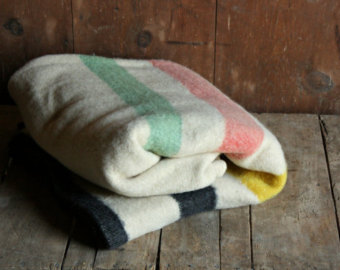
I’ve used my blanket as a makeshift leanto, a dry pad to sit down in the wet snow and I’ve wrapped up in it to wait out a sudden driving rainstorm under a tree. Wool has the unique ability to be both water repellant as well as wicking moisture vapors away from your body helping to keep you warm. You see, wool has a waxy coating that beads up the water and tends to run much of it off. This coating isn’t removed by washing. At the same time the core of the fiber allows vapors to pass through, and away from you. Wool always absorbs moisture from the side of greatest humidity and releases it to the drier side creating balance. This characteristic makes wool warm in the winter and cool in the summer. As you perspire it keeps a layer of dry air next to the skin and helps to hold in body heat. If you were to fall in a stream and saturate your wool, Very interestingly the hydrogen bond of H2O is broken in a chemical reaction within the wool molecules. It will actually generate heat; increasing your chances of avoiding hypothermia! But because the air pockets caused by the crimp in the wool fiber allows moisture to evaporate from your skin, you don't overheat when you sweat. In fact wool doesn’t feel damp to the touch until it is saturated with more than 30% of its own weight and even when moderately damp, the insulating air pockets are still intact. The same wool worn for centuries by the Bedouin tribes of the desert will keep you warm in the cold; it is a great temperature regulator.

Wool fibers can be bent 30,000 times before breaking. By comparison, a cotton fiber will break after just 3,000 times. Wool also can be stretched to 1/3 of its length dry and 1/2 wet and it will spring back to its natural size and shape. It is also abrasion resistant, and naturally UV protected while cotton and synthetics break down quickly as you wear them in the sun.  Wool can be a better and longer lasting investment for your wilderness clothing. No synthetic yet has been able to combine all of these characteristics.

Some other considerations to someone who spends much of their time in the mud and dampness of the outdoors is that wool is mildew resistant, stain resistant, and diminishes body odor. The natural wicking that we talked about prevents much of any possible problems, but wool also has anti-microbial properties and a neutrally charged surface that makes it hard for bacteria to survive on, whereas cotton and synthetics are positively charged and will attract bacteria. Studies show that bacterial colonies are common in cotton sheets while not present on wool blankets subjected to the same environmental conditions in hospitals. The thin waxy coating that makes wool water resistant makes wool very hard to stain and easy to just brush the mud off once your clothes have dried. This is also why dyeing wool is an art in itself. In the wilderness where washing clothes can be complicated and time consuming, often just a good airing out and brushing off will freshen up wool.

And as you probably know, wool is in excellent insulator layer. It has one of the highest insulation to weight ratios of any natural or man-made material, and now new spinning techniques are producing wool fabrics that are 30% lighter than was possible before.

As an example, sheep wool has been used for house insulation and has an R-value of 3.5 to 3.8 per inch of material thickness which is 0.3 to 0.6 points higher than glasswool, cellulose, and mineral wool. The crimp of the fiber also allows the wool to retain its structure and overall thickness instead of breaking down and settling like many other insulating materials. As a carpenter it is common for me to open up a wall to find a gap of 6 inches to a foot or more where blown in insulation was used and settled over time, so sheep’s wool could help significantly with preventing heat loss and
 efficiency if it were used.

If you enjoy nature it is interesting that wool can help you in several ways if you want to get close to wildlife. “They can hear you twice, see you once, but if they smell you, they’re gone.” Minimizing human odor is key to seeing animals, and there’s no fabric better than wool. Wool absorbs 30% of its weight in moisture transporting the moisture away from the skin and completely through the fabric. Nylon absorbs only 4.5% and polyester just  .4%. With these moisture remains creating bacteria and the result is odor.


Many animals eyes are much different than ours, they see different colors and also Ultraviolet light that we can’t see. Wool absorbs light while synthetics reflect it and create a bright UV shine. Even wool blends with as little as 10% synthetic materials reflect light making you more visible. 100% wool has no reflection, and a knap that absorbs sunlight making you blend in better with natural backgrounds. And lastly, wool doesn’t flap in the wind or make a sound as you move through the forest.